How to choose the right mannequin head for braiding practice
The two things that matter most when choosing a mannequin head for braiding practice.

When parents ask me,
“Which mannequin head should I buy to practise braiding?”
I know exactly why they’re confused. Go online and you’ll see hundreds of options — different hair colours, different lengths, different fibre types — and no one explaining what actually matters for beginners.
After teaching hundreds of parents and also using a head mannequin for practice myself, I can confidently say there are only two things you need to look for: the colour and the length.
Everything else is a distraction.
Let me walk you through it.
Why the hair colour matters more than you think
Most people reach for the darker mannequin heads first because they look the most “realistic.” For some people, it is the exact or similar hair colour as their kids hair. But when you’re learning a braid pattern — Dutch and French braids — you want to see every single strand and crossover clearly.
And on dark hair those patterns and mistakes disappear.
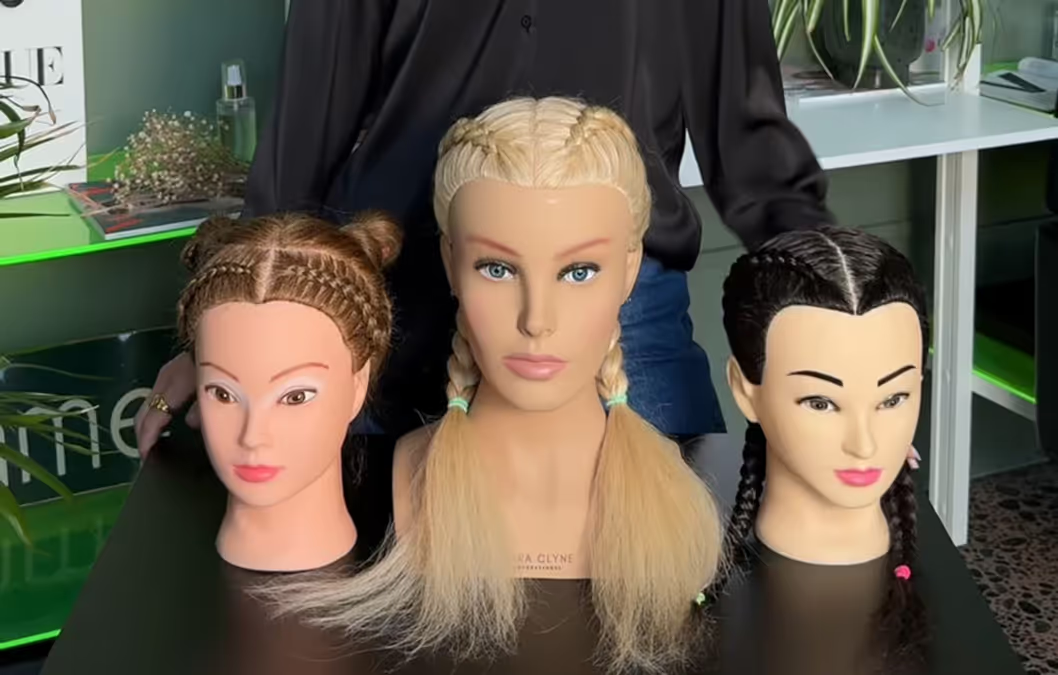
That’s why, when I compare mannequin heads in the studio, I always point out the difference:
- On dark hair, the pattern blends in and it’s harder to see what you’re doing.
- On blonde or light hair, every section, tension point, and crossover is obvious.
When parents switch to a lighter mannequin, their confidence jumps instantly because they can finally see their technique. They can tell when their tension is uneven, when a strand is twisted, or when a section is too big.
It’s like turning the lights on.
That’s why my number one recommendation for beginners is: choose a light-coloured mannequin head.
Why the hair length makes or breaks your learning
The second thing you want to look at is the length of the mannequin’s hair.
Most beginners think longer hair is better — more length to practise on, right? Not exactly.
If the hair is too long, you end up fighting with it:
- it tangles more easily
- your arms get tired
- you focus on “managing the hair” instead of learning technique
On the other hand, short hair leaves you no room to work. You finish the braid in two seconds and don’t build real control.
The sweet spot? Medium length.
Enough length to practise full braids. Not so much that you drown in it
Medium length lets your hands learn:
- how to maintain tension
- how to feed sections in consistently
- how to keep the braid aligned
- how to finish cleanly
It’s the perfect balance for learning.
A quick example from the studio
In one of my workshops, a mum brought her own, a very long-hair mannequin to practise on. She said, “I wanted the longest one so I have more hair to play with.”
But halfway through the session, she kept stopping to untangle, reset her sections, or re-do the same crossover because she got lost in the length.
When I handed her a medium-length mannequin, her entire braid came together effortlessly. Her tension was cleaner and she said, “I didn’t realise the hair length was making it harder.”
Most parents don’t.
A simple rule to follow
If you’re buying your first mannequin head, choose:
- Light coloured hair
- Medium length
That’s it. These two details will make your practice so much easier and give you faster, cleaner results.
The right tools, and the right guidance
Having the right tools and understanding the basics makes your learning curve so much smoother. Inside my Braids & Waves Community, I break braiding down simply and clearly so you can finally feel confident braiding at home.
What we do
From world-class braiding services to workshops and online courses that build confidence.